
The Chronicles of Sphear: Where Logic, Consciousness, and Desire Create Reality.
The Septan Sage

|
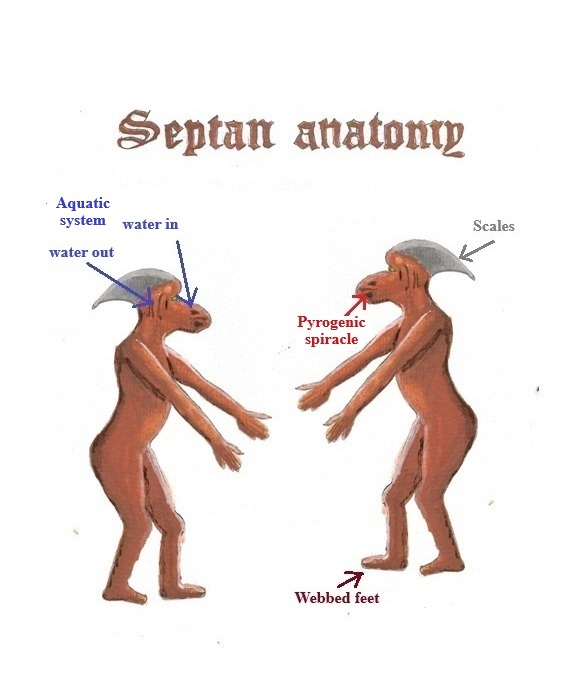
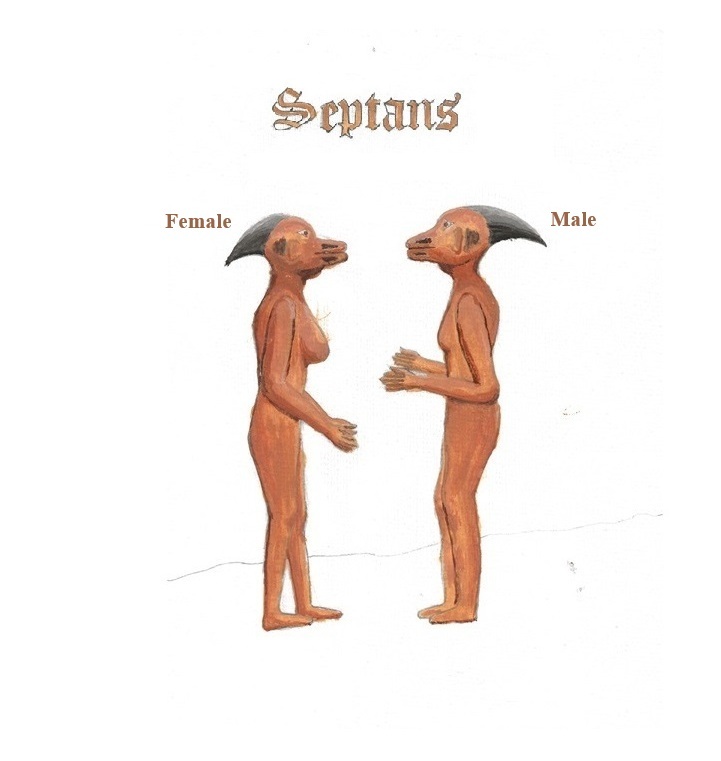
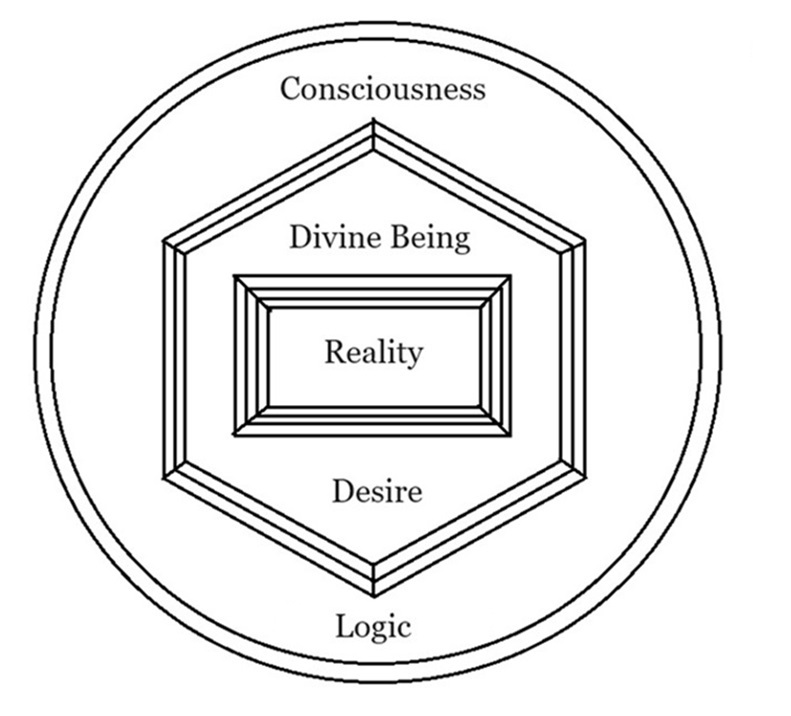
This novel features core sci-fi tropes and an intricately detailed universe. The book's scope is ambitious, and it aims to transport readers to the rich world it depicts. The story takes place in a universe where telepathic, amphibious, and pyrogenic beings known as Septans grapple with socio-political turmoil, authoritarianism, and the discovery of alien technology. They inhabit a world created by the Divine Being named Sphear. Zan, an agent of the Pallen Intelligence Agency, is the protagonist of the story. He worries about global conflict and the erosion of Septan freedom under the Republic of Shin. Zan is tasked with averting war, but soon faces a mystery as an unidentified structure appears at the North Pole. He sets out to investigate the origins of this structure along with a junior officer. Meanwhile, his personal life ties into the Spiritous faith, an ancient belief comprising five testaments, the last of which has not been revealed and is expected to define Septan destiny. Faith, authoritarianism, alien contact, and time travel shape Sphear's fate. It is a story of faith under fire, freedom under threat, and civilisations on the edge of revelation. |
|
|
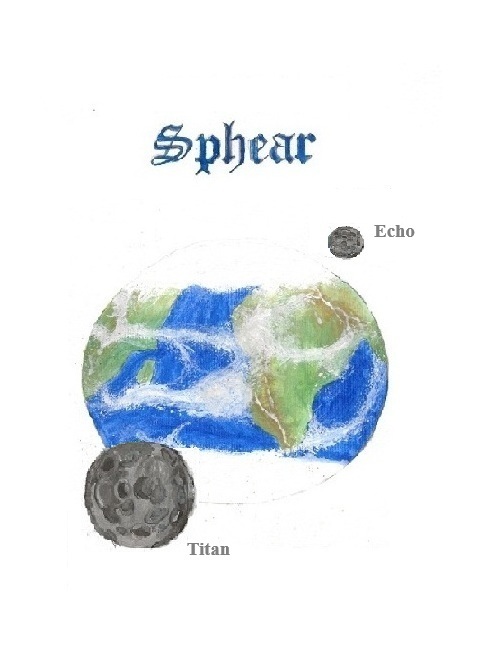
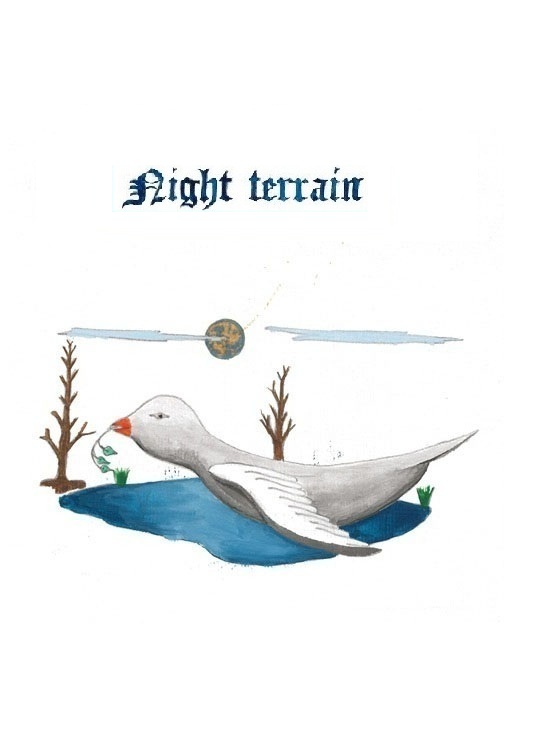
Sphear: the home of the Septan


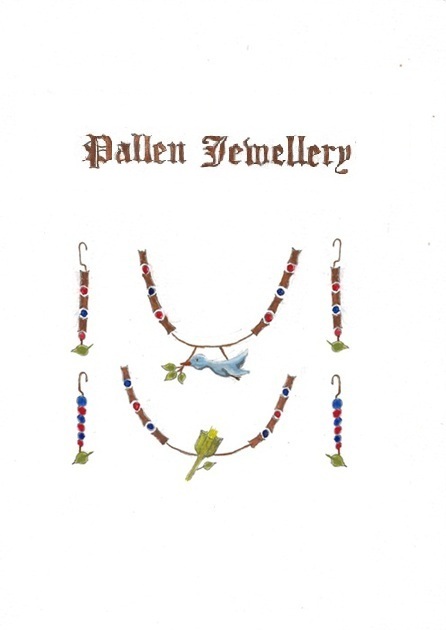
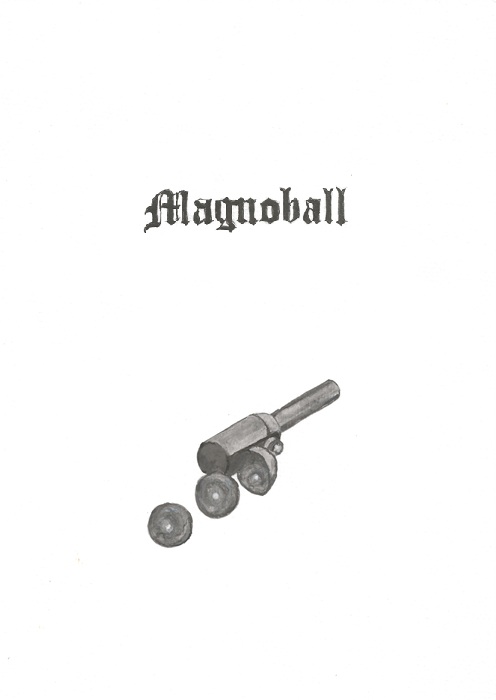
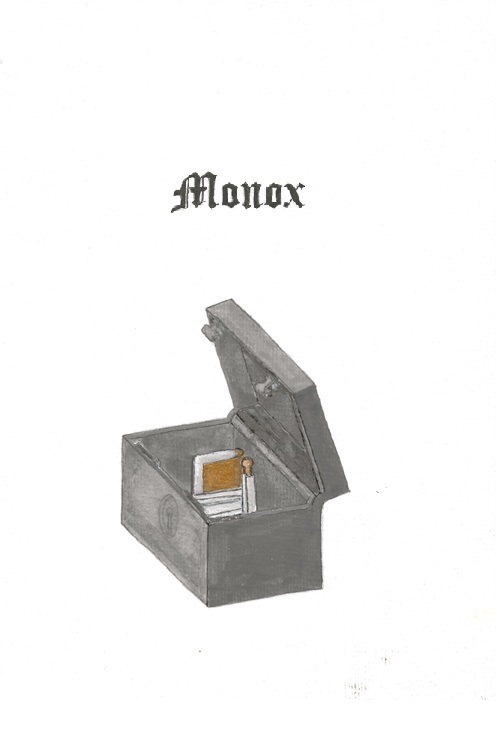
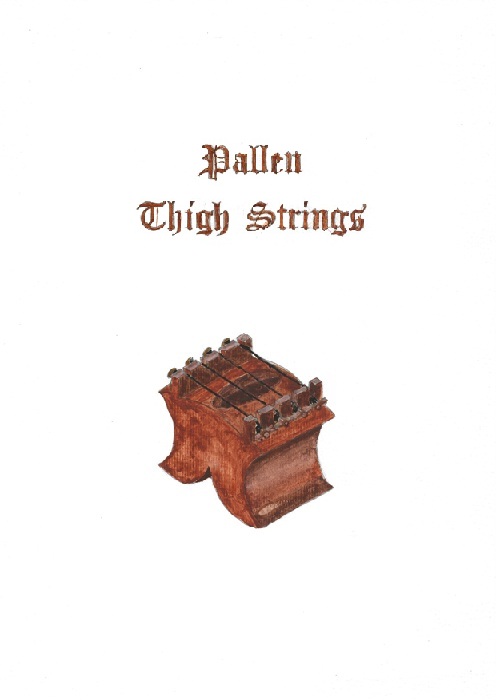
 |
About the author: Philip J. Ashton |
Born into a middle-class family in South Africa in 1966. He is the youngest of three, having two older sisters. His father was an English chartered accountant. He enjoyed an idyllic childhood until his mother's death, after which he left Africa to reside in the UK. He attended boarding schools until he was 18, where he enjoyed adventure groups and sports. He studied Electronic Engineering at the University of London, becoming unwell towards the end of his first year, which forced him to abandon his studies. Several years later, he graduated from Plymouth University with an Honours Bachelor of Science degree in Maths with Computing. His hobbies include designing items to 3D print and using watercolours. Subsequently, he began writing about the narrative he experienced during his illness. |
Sphilitar: the game of strategy
To win, you need to recover all your pieces to their starting formation, which you achieve when your Quantium occupies the central square (X) with the support of at least one allied piece and one Initiate remaining on the board, and cannot be dislodged by your opponent in his next move.
Special moves:
| 1.) Teleport rule: Can teleport from the hot squares (H) to any vacant square (Cannot chain teleport & must start turn on H to teleport). If only 3 total pieces remain per side, teleport is disabled. | 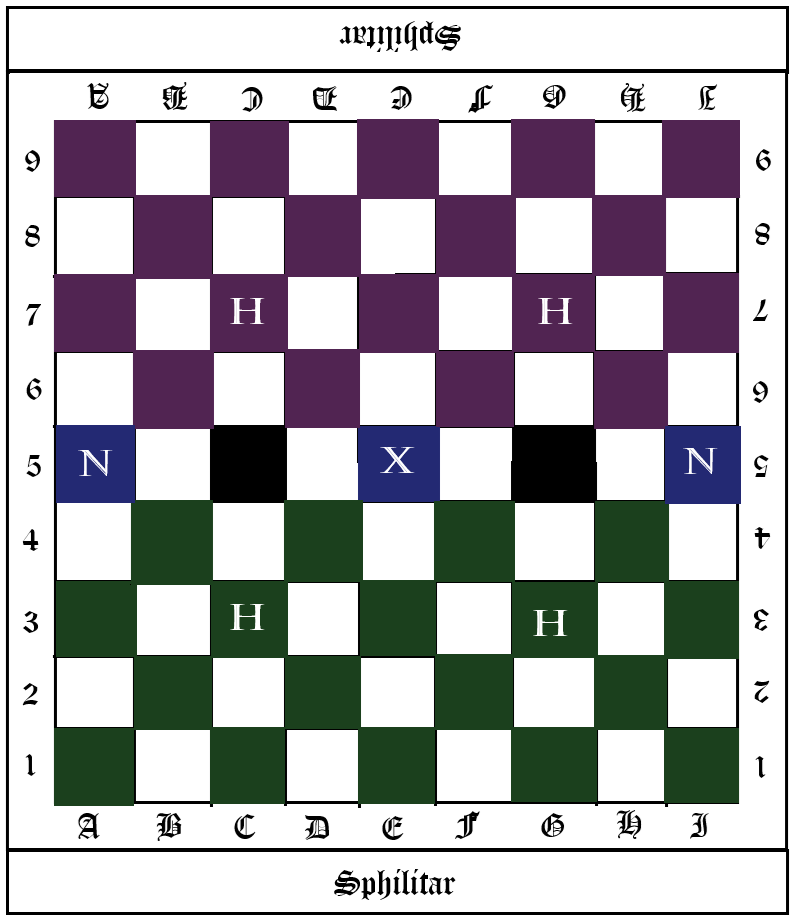
|
| 2.) Constraint rule: Occupying both command nodes (N) acquires the node control token, which restrains your opponent to only moving their Initiate pieces one square, and they lose capture ability. The control node's control expires after 2 turns unless refreshed. | |
| 3.) Mobility rule: Initiate pieces can upgrade to a guardian, ballistic, or aerial piece when they occupy the central square (X) if it survives one full opponent turn on X, but there can only be two of each. | |
| 4.) Gambit rule: Can swap the Quantium with a guardian, ballistic, or aerial piece by trading in their token (only two tokens per player). |
| Piece | Legal moves: | |
|---|---|---|
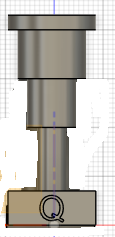
| The Quantium (One piece) moves two squares in any direction (Estimated tactical power 55- combat only) | |
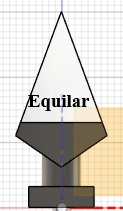
| The Equilar (One piece) moves any number of squares in any direction and can only be captured by a Guardian or a Sentinel, or by two simultaneous threats. (estimated tactical power 100) | |

| The Guardian (One piece) moves any number of squares in any direction (estimated tactical power 95) | |

| The Ballistic (Two pieces) can jump over up to four squares. Must capture if it lands on an enemy piece, but cannot land on the opponent's back row. (estimated tactical power 75) | |
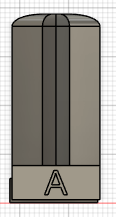
| The Aerial (Two pieces) Flies over up to two squares (estimated tactical power 65) | |
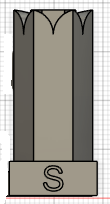
| The Sentinel (Two pieces) moves any number of squares along rows or columns only (Estimated tactical power 80) | |
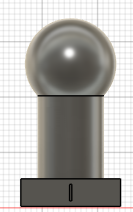
| The Initiate (Nine pieces) moves up to two squares forward or sideways, cannot move backwards and can only capture diagonally. (Estimated tactical power 30) |